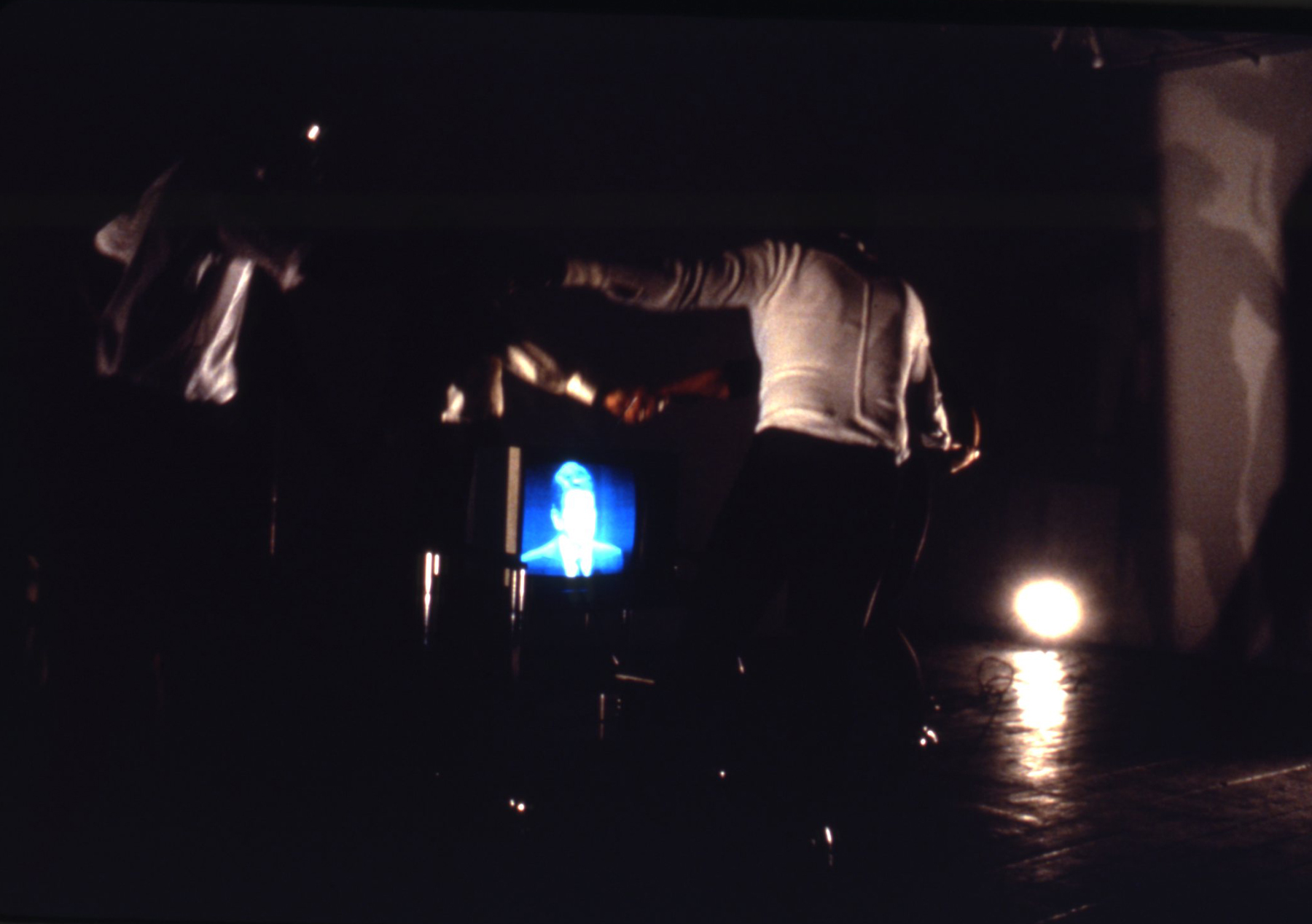
Voices (Women’s Building, still 2)

22 06 2010

Artist: Maren Hassinger Current repository: Collection of Maren Hassinger
Location: Women’s Building, Los Angeles Source: Maren Hassinger
Title: Voices Rights:
Medium: 35mm slide Comments: Hassinger writes that “’Voices’ was first performed at The Women’s bldg. in Los Angeles in 1984. It was the separate voices of 6 people made into an orchestra by a conductor. I wrote and directed the action. The conversation was about our relation to nature in the political realm in which we found ourselves.” In a statement read aloud at the end of the 1985 performance, Hassinger states that Voices articulates “concern for the role of nature in an increasingly technological society.” The performance includes video edited by Ulysses Jenkins and quotations from the novels of Walker Percy. It is one of several performances Hassinger describes in her “Manifesto” as “Post-modern commentaries on politics, the end of nature, etc.,” created for friends, including Senga Nengudi and Ulysses Jenkins (“classmates from Lester Horton dance classes”) and Dee McMillin (“a student from Cal Arts”).  In 1985, other cast members included Mary Abrams, Cindy Kahn, and Chris Troy. For the premiere performance at the Women’s Building, May Sun conducted the performers; in 1985, Hassinger served as conductor.

Dimensions: Date: 1984


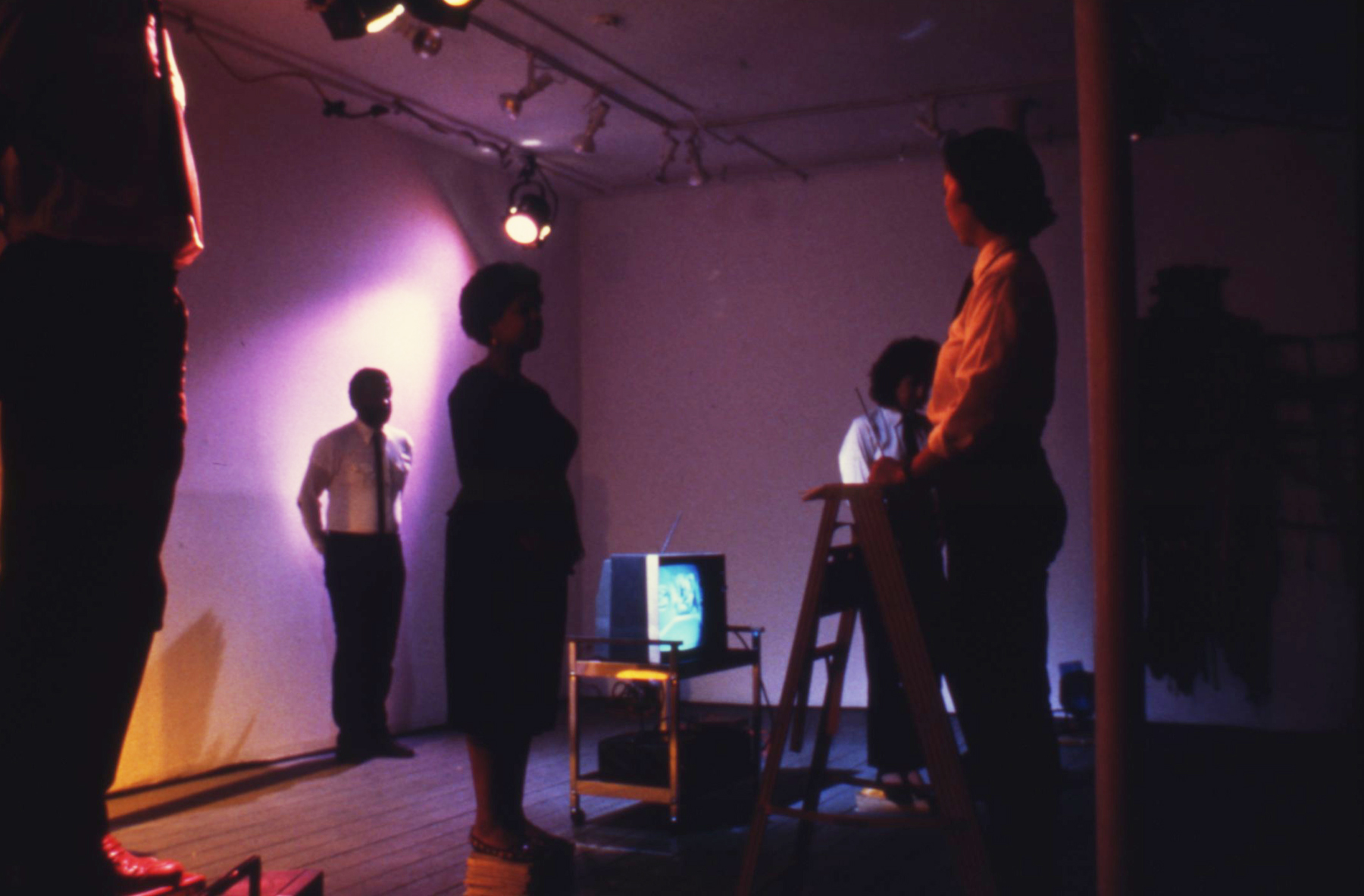
Voices (Women’s Building, still 1)

22 06 2010

Artist: Maren Hassinger Current repository: Collection of Maren Hassinger
Location: Women’s Building, Los Angeles Source: Maren Hassinger
Title: Voices Rights:
Medium: 35mm slide Comments: Hassinger writes that “’Voices’ was first performed at The Women’s bldg. in Los Angeles in 1984. It was the separate voices of 6 people made into an orchestra by a conductor. I wrote and directed the action. The conversation was about our relation to nature in the political realm in which we found ourselves.” In a statement read aloud at the end of the 1985 performance, Hassinger states that Voices articulates “concern for the role of nature in an increasingly technological society.” The performance includes video edited by Ulysses Jenkins and quotations from the novels of Walker Percy. It is one of several performances Hassinger describes in her “Manifesto” as “Post-modern commentaries on politics, the end of nature, etc.,” created for friends, including Senga Nengudi and Ulysses Jenkins (“classmates from Lester Horton dance classes”) and Dee McMillin (“a student from Cal Arts”).  In 1985, other cast members included Mary Abrams, Cindy Kahn, and Chris Troy. For the premiere performance at the Women’s Building, May Sun conducted the performers; in 1985, Hassinger served as conductor.

Dimensions: Date: 1984


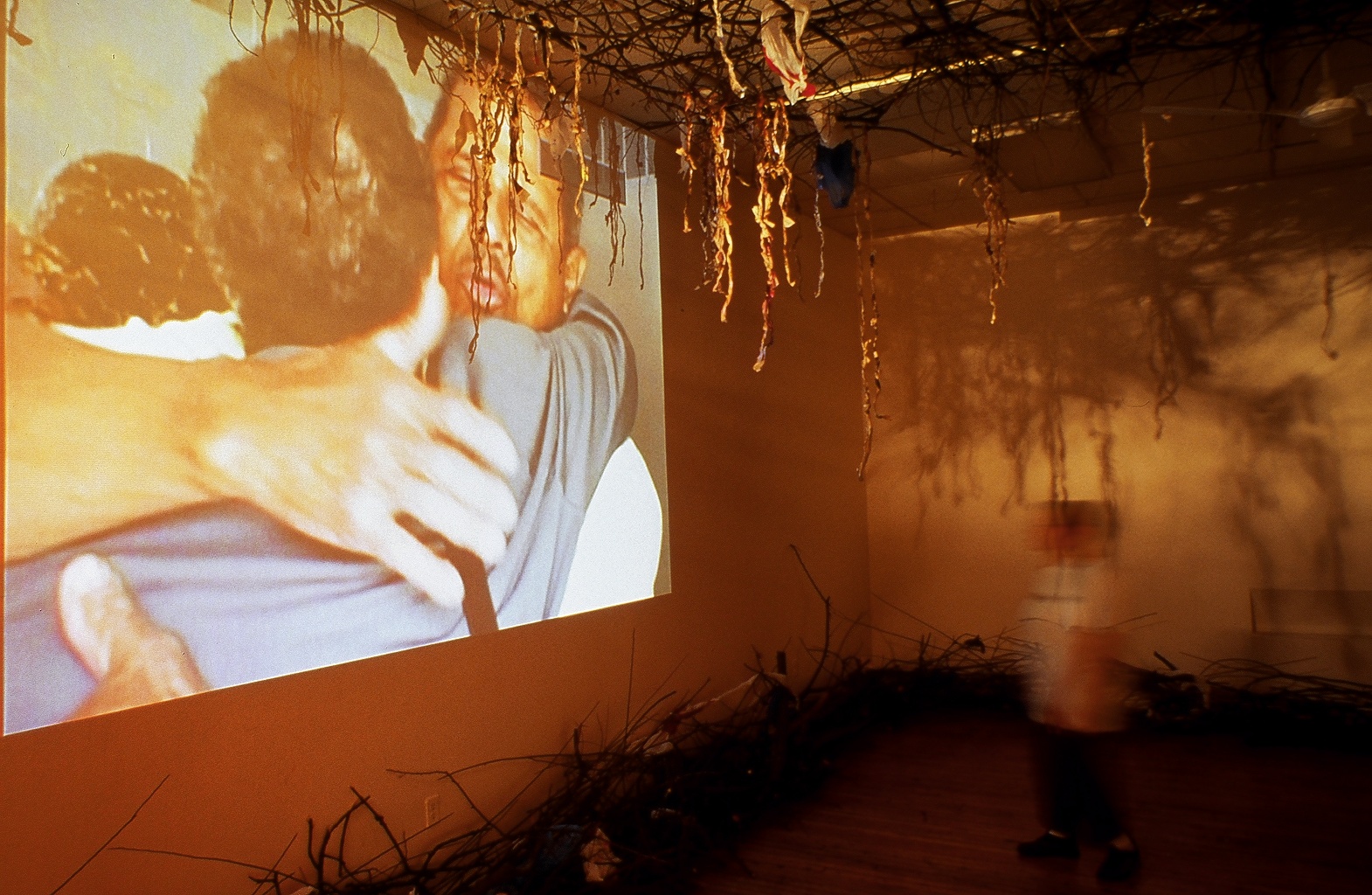
The River

14 06 2010

Maren Hassinger writes of “The River” that, “The installation conforms to the limits of the space. The installation consists of debris that might be washed ashore during a flood.”

A reviewer described Hassinger’s installation at School 33 Art Center: “The first floor’s ceiling is covered with a thicket of branches and plastic bags and a great beard of dirty, knotted newspaper cascading down like a waterfall of trash, as if the viewer is some mud-dwelling croaker looking up from the bottom of a polluted river. That’s fitting, considering artist Maren Hassinger uses the metaphor of a flowing river sweeping debris downstream to illustrate how trouble travels through families. Her installation, titled simply ‘The River,’ includes a projected video of Hassinger’s interview with a long-lost uncle who unskeins their family’s tangled, incestuous genealogy: Hassinger’s troubled grandmother was the offspring of a white woman and her nephew, the son of her father’s Cherokee mistress.”

See Violet Glaze, “The River, New Work, Ex Libris: Rethinking the Library,” Baltimore City Paper (July 27, 2005).

Artist: Maren Hassinger Current repository:
Location:  School 33 Art Center, Baltimore, Maryland Source: Maren Hassinger
Title: The River Rights:
Medium:35mm slide Comments: “The River” is an installation made with tree branches, plastic bags, and old newspapers, with a ten-minute video projection.
Dimensions: Date: June 4-30, 2005


Why Did This Happen?

10 06 2010

Maren Hassinger describes the artwork: “Questionnaire about 9/11. After the opening, notebooks were left in the gallery and the viewers were asked to complete the form on their own.” A reviewer described the piece: “Maren Hassinger solicits response with her Why Did This Happen? that consists of a notebook of paper on which participants may provide their answer.”

Hassinger presented Why Did This Happen? in an exhibition, “Unforgettable,” featuring artworks that responded to the events of 9/11. Curated by Judy Collischan for Chelsea Studio Gallery, New York, the exhibition ran September 5-28, 2002. Hassinger also presented this work at the “Faculty Show,” Maryland Institute College of Art, Baltimore, in 2002.

For a review of “Unforgettable,” see “Ausschreibung ‘Unforgettable’ @ Berliner Kunstprojekt,” NYArts (December 2002).

Artist: Maren Hassinger Current repository: Collection of the artist
Location:  Chelsea Studio Gallery, New York Source: Maren Hassinger
Title: Why Did This Happen? Rights:
Medium:35mm slide Comments: In this photograph, Maren Hassinger is seated with her back to the viewer.
Dimensions: Date: 2002


Manifesto

9 06 2010

Maren Hassinger notes, “The following is a manifesto I wrote for Senga [Nengudi] and myself, probably on the occasion of our visit to Paris in 2006.” Hassinger and Nengudi traveled to Paris to present their collaborative video, Side by Side, which explores their work together since the 1970s.  They presented the video at “Les soirées nomades: Nuits Noires” at the Fondation Cartier por l’art contemporain, Paris, France for which Hassinger also created Women’s Work.

Manifesto

Manifesto pg. 1

“We”

Since 1978 (during CETA, Title VI) we’ve been working alone and together as our paths crossed.  Sometimes it was a sculptural collaboration, but more often, we performed in each others works.  Events, process, ideas were shared in (list pieces).

What was the nature of the work done together?  A sense of play and improvisation was always at the core of our process.  Senga might say, “Oh, I saw this big hole where they demolished Broadway Wilshire.  We should see that.”  Then off we’d go to see the hole.  We all agreed it was a big hole.  Years later Houston made a cubic hole in the ground in Atlanta and filled its shored up sides with niches containing secrets.  I made swirling round wire rope pieces, etc.  Nothing explicit — but a shared moment individually interpreted.  Often these shared moments seemed incredibly awkward to me.  I didn’t always understand why I was looking at these exciting feats of (de)construction.  Senga’s process seems to have a lot to do with this unknowingness, but a feel for the rightness of the effort.  Maybe this stems from her dada/surrealist roots.

In cases like “Blanket of Branches,” (1986) I told Senga and Ulysses that I was doing this installation at the Contemporary Arts Forum in Santa Barbara and invited them to perform within (under) this canopy of branches at the opening.  We all (Frank Parker was also in the cast) appeared in Senga’s piece, “Nature’s Way.”  Ulysses piece was (discuss his piece).

In 1984 I told everyone I had written “Voices.”  We had been working with Rudy Perez (in Ulysses’ studio) and we all gathered as personnel for “Voices.”  Other performers included classmates from Lester Horton dance classes and a student from Cal Arts. (get names)

Conceptually all these pieces are marked with a distinctive physicality probably derived from our shared interest and pursuit of dance.  Senga’s humor and quirky (psychologically and sexually charged) interpretations of reality surface in “Las Vegas Ikebana.”  Maren’s desires for unity are apparent in “Voices.”  A shared romanticism is apparent in Senga’s poster of myself and Frank Parker dancing  and in Maren’s contributions to “Las Vegas Ikebana” and the installation of “Our Book.”

Post-modern commentaries on politics, the end of nature, etc., are apparent in our approaches in “Voices” and “Las Vegas Ikebana.” (others?).          Maren’s minimalist inclinations have brought a sympathy with architecture, repetition. and site inspired forays.  “Flying” is an example.

Now, as we celebrate 35 years in art, we haven’t heard of any other collaborations between African American women in the area of performance and installation.  We know of some individuals (Adrian Piper, Lorraine O’Grady, et al), but never people working together.  So, we are unprecedented.  AND the collaboration is particularly important when you consider what exactly is commingled here.  We are nearly textbook examples of the art historical crossover from modernism to post modernism practiced during the past 50 years.  Senga’s roots are dada and surrealism, mine are minimalism.  We both shared a background in dance training (specificallly with students and company members of Lester Horton in Los Angeles).  We have both gravitated towards explorations involving sculptural objects, installations, performance.  I became enamored of using film and video.  Senga is obsessed with still images.

Because Senga’s work employs pseudonymous personalities who engage in diverse art

Manifesto  pg. 2

activities (e.g., Harriet Chin is a draughtsperson), her involvement with this collaboration can be seen as an extension of that impulse.  It is Senga, the dancer or talker/mail writer, who participates in these works.

Maren’s involvement probably stems from a desire to work communally towards goals with (possibly) wider connotation, application, and appreciation.  By combining efforts the total might be greater than the sum of either part.  Something actually NEW might happen, or at least, something inspiring….  These pieces together also are a concrete examples of the unity Maren has frequently cited as a goal of her recent solo work.

We’ve kept each other such good company all these years and we’ve had so much fun doing it, that it’s hard to separate the abiding friendship from the issues of theory and practice.  Finally, it seems we’ve collaborated and those times together have kept us making art, maintained our curiosity(when much else failed), and stepped up the ante in art history.  Our times together making work have healed many difficult moments wrought by (these only childs’) lives.

Senga — risky, spunky, sexy, outstandingly absurd — hanging stuff off the demolition site and Maren flopping around all this wire rope to make a row of steel trees mourning nature’s passing while proclaiming the authority of its replacements, combine to produce pieces of rare power and imagination.

(If this is text, show illustrations of each.  If this were a slide show, show these now on split screen.)


Clifford Owens visits UNC-Chapel Hill, November 2-13, 2009

9 06 2010

In conjunction with John Bowles’ fall graduate seminar, the Art Department brought Clifford Owens to the University of North Carolina, Chapel Hill, for a two week residency, November 2-13, 2009. As the Hanes Visiting Artist, Owens created two performances of Photographs with an Audience for the Process theater series, staged a series of actions in the Alumni Sculpture Garden and elsewhere across campus, presented a public lecture, and met with graduate students working on the African American Performance Art Archive.

Below, a selection of the media coverage documenting Owens’ residency.  Click a heading to follow the link:

Artist Clifford Owens visits UNC Nov. 2-13

UNC-Chapel Hill College of Arts & Sciences press release, October 2009.

The Process Series and Clifford Owens

Interview and profile of Clifford Owens for the Independent newspaper, November 4, 2009.

Clifford Owens visiting artist

Brief story about Clifford Owens’ performances from the Durham Herald-Sun newspaper, November 2009.


AAPAA featured in CHAT Festival exhibit, Feb. 16-19, 2010

9 06 2010

The African American Performance Art Archive was featured in an exhibition of faculty research projects sponsored by the Institute for the Arts and Humanities’ CHAT Festival (Collaborations: Humanities, Arts & Technology) at the University of North Carolina, Chapel Hill, February 16-19, 2010.

The CHAT Festival’s mission was to explore how “digital technologies are transforming the practices of the arts and humanities, including how we learn, think, know, teach and express ourselves both as individuals and as communities.” Festival events included live performances, a series of panels and lectures, and exhibitions of collaborative projects created by scholars at UNC-Chapel Hill, Duke University, and North Carolina State University.

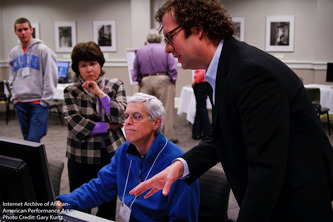
Photo: John Bowles demonstrates the Archive to CHAT Festival attendees.

Below, a selection of CHAT Festival coverage documenting the Archive’s participation.  Click a heading to follow the link:

Internet Archive of African-American Performance Art

A CHAT Festival announcement with a description of the African American Performance Art Archive and exhibition details.

Photos from Faculty Exhibitions

Photo gallery documenting the CHAT Festival, including a photograph of John Bowles at the exhibition of faculty projects, demonstrating the site to visitors.

CHAT Festival’s Photos – Faculty Working Groups

Photo gallery documenting the Faculty Working Groups held in preparation for the CHAT Festival. John Bowles appears in two of the photographs.

Photo: CHAT Festival participants Paul Jones and John Bowles at one of the Faculty Working Groups, summer 2009.


Women’s Work

23 04 2010

Maren Hassinger first performed Women’s Work in conjunction with her collaborative performance with Senga Nengudi, Side by Side, at “Les soirées nomades: Nuits Noires,” at the Foundation Cartier pour l’Art Contemporain, Paris, France, in April 2006.  Hassinger explains, “‘Women’s Work’ was my individual creation. Senga had an individual creation and then we made an extended piece together [Side by Side] which involved a video review of our work together over the years and a gift giving segment involving the Paris audience.”

Hassinger adds, “In 2009 the ‘Women’s Work’ piece was reprised during an evening of performance organized by Ulysses Jenkins called ‘Quiet as Kept’ at the California African American Museum (CAAM) in Los Angeles.  This evening was in honor of my receiving the Lifetime Achievement Award from the Women’s Caucus [for Art] that year and to the many African American women artists of Los Angeles.  Many of them were present that night, including Senga.”


Artist: Maren Hassinger Current repository: Collection of Maren Hassinger
Location: Foundation Cartier pour l’Art Contemporain, Paris, France

Source: Maren Hassingeri
Title:  Women’s Work Rights:
Medium: video Comments: Performed in conjunction with Hassinger’s collaborative performance with Senga Nengudi, Side by Side, at “Les soirées nomades: Nuits Noires.”

Dimensions: Date: April 2006


An Abbreviated Biography of Benjamin Patterson

15 12 2009

In 1998, SEM Ensemble performed Ben Patterson’s Pond 2 at the Paula Cooper Gallery in New York City.  In 2007, artist Clifford Owens, in conjunction with artist Xaviera Simmons performed Four Fluxus Scores by Benjamin Patterson. This included Patterson’s seminal work, Lick Piece in which a female subject is covered with whipped cream.  And in 2008, a group of volunteers in conjunction with Patterson at The National Museum of Modern Art in New Delhi, India re-staged Ben Patterson’s Paper Piece, a performance event that opened the first Fluxus Festival in Wiesbaden, Germany in 1962.  These reincarnations of Patterson’s work, just a few among many others, suggest that he has been influential and important for a number of contemporary artists and that there is something about his work that remains relevant in the contemporary moment.  The current biography explores Patterson’s career as well as the challenges that a study of Patterson’s work and the movement of which he was part, introduce.

Ben Patterson was born in 1934 in Pittsburgh, Pennsylvania and is best known, for his participation in the international artists group, Fluxus.  It is both integral and slightly risky to discuss Patterson in this context as Fluxus itself proves difficult to define and is debated in contemporary scholarship.  Specifically, critics of the movement understand it in ways that are significantly different from those of its participants.

With respect to its structure, this international artists group is best described by Kristine Stiles as a “voluntary association of people”[1].  Another scholar in Ken Friedman’s Fluxus Reader concurs when she states that what united many Fluxus artists was a mutual interest in each other’s work and collaborations on projects and performances.[2] Underscored in these statements is the formal, aesthetic diversity amongst Fluxus artists that make its encompassing work very different.  Fluxus was originally conceived of as a publication with no cultural or political agenda when the name was coined in 1961.  It

was only as Fluxus developed that it began to be associated with a group of specific artists and events.[3] Many texts name Dick Higgins, Yoko Ono, Nam June Paik, George Maciunas and George Brecht the core of the group of artists.  While records seem to suggest that Patterson was an integral member from its birth, the artist does not figure prominently in Fluxus scholarship and research on Patterson yields few significant resources.

In his Discovery of Alternative Theater, Richard Kostelanetz argues that the fullest realization of Fluxus was at its first official event in Wiesbaden, Germany in 1962, ‘Fluxus Internationale Festspiele Neuster Musik’.[4] It included 14 concerts whose composers were grouped according to style, nationality and medium.  Fluxus was originally conceived by George Maciunas, however, as a publication.  One of its original goals was “to create a distribution system for interesting materials that would not otherwise be published.”[5] In 1964, the members of the group released their first publication Fluxus I. It contained enveloped with scores Higgins, Patterson and Brecht, amongst others.  Objects, photographs and other performance remnants also made up the contents of the compilation.

While the structure of Fluxus and its participants are fairly accessible, chronologically, the period is much more elusive.  Some literature argues that Fluxus is a non-durational movement that transcends a typical temporal framework for an art or political movement[6].  These artists and scholars view the term Fluxus as inextricably bound to the idea of flowing and change that is resists the notion of a fixed end.  Other scholars and critics of the movement understand a clear incipience and convergence of activity from the late 1950’s to the mid-1960’s a decline after 1963.  During the years from 1967 to 1969 little work was produced.  Similarly, other scholars believe that Fluxus is now over.

The ideological foundation and goals of Fluxus are also contested.  There is a strong belief on the part of many Fluxus participants like Dick Higgins, that Fluxus was an aesthetic and political movement that challenged accepted methods of art production with respect to materials and strategies of representation.  Many of its most prominent leaders, such as George Maciunas, also believed that Fluxus was an anti-institutional group, wildly different from contemporaneous and immediate past art historical art historical periods such as Dadaism.  They were especially weary of the abstraction of the fine art world.  Extraordinarily self-aware, members of the group also attribute the impetus for their practices to the varying political actions of the United States government such as the war in Vietnam and other actions viewed as establishing the US’ world power (or domination).[7] Furthermore, many were interested in the social and political implications of their work.  Together, these artists articulated a vision that characterizes Fluxus as idealistic, iconoclastic and anarchic.  Contemporary scholars, however, challenge this notion and prove that the work of Fluxus was in many ways “traditionally iconoclastic” with its use of easily destroyed, quotidian, ephemeral materials and happenings.”  One scholar, Hannah Higgins argues that politically, Fluxus was in reality narrowly focused as she expose the self-aggrandizing mythology of Fluxus perpetuated by its principal artist, George Maciunas.  She also argues that they were a group with many ideas about political power that were not always interested in certain types of widespread activism.

Finally, while Dick Higgins asserts that Fluxus never forced its participants to adhere to any clearly defined program, much scholarship on the movement compellingly exposes internal conflicts that describe Maciunas as an aesthetic tyrant who did not include the work of those whose work he believed strayed from a collective vision that he had of Fluxus.

Ben Patterson, a 1956 graduate of the University of Michigan at Ann Arbor’s Music program, both conforms to and differs from some of the accepted Fluxus ideologies and practices.  Like many other Fluxus artists, Patterson engaged in different types of work which were at their core experimental and performance-based.  His work is wide and can be understood as existing in and between systems of classification such as ‘art’, ‘music’ and ‘text’.  For example, in 1960, after working a musician with

various orchestras in the United States and Canada, Patterson moved to Cologne, Germany.  There, he became active in the radical music scene and he worked with the composer Karlheinz Stockhausen who was a leader in avant-garde music and performance.  In classes with Stockhausen, he created compositions that he would perform later on at Fluxus Festivals.[8] Thus, like the practices of other Fluxus artists, some his work constituted discrete events.  Patterson also, however, produced publications and collections of objects such as Instruction No. 2 and Black and White File. Patterson moved to Paris to in 1961 and in 1962 published a collection of his scores entitled Methods and Processes.

With respect to ideology, some of Patterson’s work also conforms to the institutional and aesthetic idealism and activist-like goals championed by the larger Fluxus group.  For example, one of his most famous works, Paper Piece stands in striking contrast to high-world of abstract expressionism through its medium and overt political position.  Paper Piece begins with two performers who exit the wings of the stage and entering the space of the audience.  Holding this long sheet of paper over the very front row, audience members heard the sound of paper being shredded and crumpled.  Soon after, holes appeared in a large paper screen onstage.  Following this, shredded paper and balls of paper were thrown into the audience and printed sheets of letter-sized paper were dumped on to the audience as well.  On these sheets of paper was George Maciunas’ Fluxus manifesto that stated:

“Purge the world of bourgeois sickness, intellectual, professional & commercialized culture, PURGE the world of dead art, imitation and artificial art, abstract art, illusionistic art, PURGE THE WORLD OF EUROPEANISM…PROMOTE A REVOLUTIONARY FLOOD AND TIDE IN ART, Promote living art, anti-art, PROMOTE NON-ART REALITY to be grasped by all peoples, not only critics, dilettantes and professionals…FUSE the cadres of cultural, social & political revolutionaries into united front & action.”[9]

These charged words, articulating vehemence with the particular characteristics of art institutions in the militant language of 1960’s political movements for enfranchisement and equal rights graced the pages of one of Ben Patterson’s first Fluxus performances.  And they place him within the idealism of its group.

Patterson also produced more ambiguous work that takes the form of physical objects.  One example of this is Instruction No. 2. This work constituted a small, white plastic box with “Fluxus”, Patterson’s name and the title of the piece on the label.  In striking contrast to the bold, political message of Paper Piece, inside each box was a piece of soap and a stamped paper towel that said “Please wash your face”.  This object included ephemeral, common items that are squarely in line with the concerns of Fluxus members and is formally similar to Ken Friedman’s Open and Shut Case.

Finally, with respect to the duration of his career, Ben Patterson was very active in the 1960’s producing works that define his oeuvre like Lemons and Solo for Double bass.  Additionally, the artist still works today.  After a seventeen year break from art production that began in 1970, Patterson had an exhibition at the Emily Harvey Gallery in New York entitled Ordinary Life. In 2002, he created a space called Ben’s Bar in New York.  The space was reinstalled in Wiesbaden in 2007.  In 2006, he opened his Museum for The Subconscious, a virtual space that he states is situated both in Namibia, Africa and everywhere at the same time.  In 2009, he executed performances and object based installations at the SolwayJones Gallery in Los Angeles, California.

Similarly, Patterson’s work continues to be explored by artists, curators and scholars even though literature about the artist and reproductions of his scores are difficult to obtain.  He was included in the Sao Paolo Bienal in Brazil in 1983 as well as a broader 1999 Fluxus retrospective in Tel Aviv entitled Fluxus in germany.  Additionally, A Very Lawful Dance was recreated with the aid of New York City’s Art in General gallery. And planned for the future is a forty year retrospective of Patterson’s work organized by the Contemporary Arts Museum of Houston.


[1] Hannah Higgins, “Fluxus Fortuna” in The Fluxus Reader, Ken Friedman (Chicester: Academy Editions, 1998), 32.

[2] Jon Hendricks, Fluxus Codex (New York: Gilbert and Lila Silverman Fluxus Collection in association with H.N. Abrams, 1988), 24.


[3] Jon Hendricks, Fluxus Codex (New York: Gilbert and Lila Silverman Fluxus Collection in association with H.N. Abrams, 1988), 16.


[4] Ibid., 12.

[5] Eric Drott, “Ligeti in Fluxus,” The Journal of Musicology 21, (2004): 213.

[6] Owen Smith, “Developing a Fluxable Forum” in The Fluxus Reader (Chicester, England, Academy Editions, 1988) , 19.

[7] Jon Hendricks, Fluxus Codex (New York: Gilbert and Lila Silverman Fluxus Collection in association with H.N. Abrams, 1988), 21.  Foreword states that “Fluxus begins before it begins and ends, one hopes after it ends.”


[8] Kristine Stiles, “Between Water and Stone, Fluxus Performance: A Metaphysics of Acts,” in Elizabeth Armstrong and Joan Rothfuss, eds, In the Spirit of Fluxus, (Minneapolis: Walker Art Center, 1993).

[9] Owen Smith, “Developing a Fluxable Forum” in The Fluxus Reader (Chicester, England, Academy Editions, 1988), 11.

Bibliography

Fluxus, 25 Years. Williamstown: Williams College Museum of Art, 1987.

Armstrong, Elizabeth, Joan Rothfuss, and Simon Anderson. In the Spirit of Fluxus: Published on the Occasion of the Exhibition. Minneapolis: Walker Art Center, 1993.

Drott, Eric. “Ligeti in Fluxus,” The Journal of Musicology 21, (2004): 201-240

Friedman, Ken. The Fluxus Reader. Chicester: Academy Editions, 1998.

Hendricks, Jon. Fluxus Codex. New York: Gilbert and Lila Silverman Fluxus Collection in association with H.N. Abrams, 1988.

Higgins, Hannah. Fluxus Experience. Berkeley: University of California Press, 2002.

Kostelantez, Richard, “The Discovery of Alternative Theater: Notes on Art Performances in New York City in the 1960’s and 1970’s.” Perspective of New Music 27 (1989): 128-172.


Senga Nengudi Thematic Essay

14 12 2009

“I relish in Creating art wherever my I my lazy eye finds it,” writes Senga Nengudi as persona Lily Bea Moor in her poem, “Lilies of Valley Unite! Or not.” The line sings of an artist whose capacity to unleash the expressive power of quotidian materials has transformed spaces through performance and installation since the 1970s. Things torn and discarded—pantyhose, newspaper, masking tape— are imbued with metaphor in Nengudi’s hands. In R.S.V.P (1976) worn nylons stretch like spider webs from one wall to another. Weighed down by sections of sand, and sometimes a scrap of metal, the pantyhose reference the women’s bodies that they once garmented. Splaying nylons across the gallery until its multicolored skins are at the point of breaking, Senga Nengudi knits significance anew.

Interconnectivity is a thematic element within this oeuvre where materials and performance transcend artistic genre and tie together cross-cultural influences. In Nengudi’s sand-painting, From One Source Many Rivers (2004), pools of blue and currents of deep ochre drifted through the spot-lit museum interior.  Shown at Carnegie Museum of Art in Pittsburg, the site synthesized techniques from Tibetan mandalas, Navajo sand paintings, and aboriginal ground paintings. “I like to dance with space I occupy,” reports Nengudi, and this installation echoed that statement in the traces of sand, pigments and fossils that the artist left in her wake.

Rhythm underscores the play of sound, light, and innovation in works such as Warp Trance (2007), which was a project that she designed while Artist in Residence at the Fabric Workshop and Museum in Pennsylvania. Weaving together themes of art and labor, this installation created a hypnotic environment by projecting audio and video recordings from textile mills onto recycled Jacquard punch card panels. As such, visitors were inundated with the collusion of the mechanical pasts and digital futures that the Jacquard loom signifies.

Nengudi also draws inspiration from interpersonal relationships, even as she creates them. For instance, her ongoing performance “Walk a mile in my shoes,” sends shoes to others in the U.S. and abroad with the request her recipients to walk/dance a full mile in the shoes and return their documentation. Collaborative projects are recurrent events; in addition to her long time friendship with Maren Hassinger, Nengudi has worked with performance artists such as David Hammons, Lorraine O’Grady and Houston Conwill.

by Diane Woodin