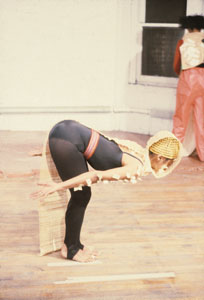
Alive Performance slide 4

14 12 2009

slide 4

Artist: Senga Nengudi, Maren Hassinger, and Frank Parker Current repository:
Location: Exploratorium, California State University, Los Angeles Source: Senga Nengudi
Title: Alive Performance, a collaborative performance by Senga Nengudi, Maren Hassinger, and Frank Parker Rights:
Medium: 35mm slide Comments: Pictured: Franklin Parker and Senga Nengudi.
Dimensions: Date: July 16, 1980


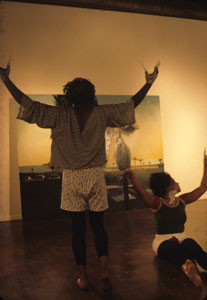
Alive Performance slide 3

14 12 2009

slide 3

Artist: Senga Nengudi, Maren Hassinger, and Frank Parker Current repository:
Location: Exploratorium, California State University, Los Angeles Source: Senga Nengudi
Title: Alive Performance, a collaborative performance by Senga Nengudi, Maren Hassinger, and Frank Parker Rights:
Medium: 35mm slide Comments: Pictured: Franklin Parker and Senga Nengudi.
Dimensions: Date: July 16, 1980


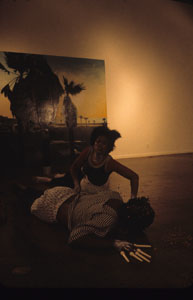
Alive Performance slide 2

14 12 2009

slide 2

Artist: Senga Nengudi, Maren Hassinger, and Frank Parker Current repository:
Location: Exploratorium, California State University, Los Angeles Source: Senga Nengudi
Title: Alive Performance, Kiss Yourself, Senga Nengudi and Audience Participants in performance at California State University. Rights:
Medium: 35mm slide Comments: Pictured: Senga Nengudi and audience participants.
Dimensions: Date: July 16, 1980


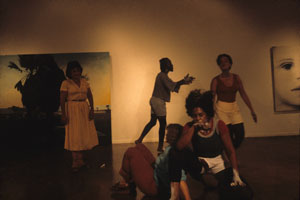
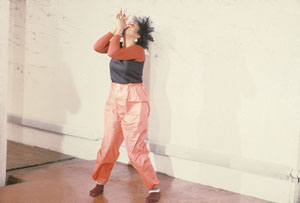
Alive Performance slide 1

14 12 2009

slide 1

Artist: Senga Nengudi, Maren Hassinger, and Frank Parker Current repository:
Location: Exploratorium, California State University, Los Angeles Source: Senga Nengudi
Title: Alive Performance, a collaborative performance by Senga Nengudi, Maren Hassinger, and Frank Parker Rights:
Medium: 35mm slide Comments: Pictured: Maren Hassinger, Franklin Parker, and Senga Nengudi.  Collaboration between Senga Nengudi, Maren Hassinger, and Franklin Parker.
Dimensions: Date: July 16, 1980


Air Propo slide 4

14 12 2009

slide 4

Artist: Senga Nengudi Current repository:
Location: Just Above Midtown Gallery, New York Source: Senga Nengudi
Title: Air Propo Rights:
Medium: 35mm slide Comments: Pictured: Butch Harris.  A collaboration between Senga Nengudi, Cheryl Banks and Butch Morris. Sponsored by the New York State Council and Meet the Composer.
Dimensions: Date: 1981


Air Propo slide 3

14 12 2009

slide 3

Artist: Senga Nengudi Current repository:
Location: Just Above Midtown Gallery, New York Source: Senga Nengudi
Title: Air  Propo Rights:
Medium: 35mm slide Comments: Pictured: Senga Nengudi.  A collaboration between Senga Nengudi, Cheryl Banks and Butch Morris. Sponsored by the New York State Council and Meet the Composer.
Dimensions: Date: 1981


Air Propo slide 2

14 12 2009

slide 2

Artist: Senga Nengudi Current repository:
Location: Just Above Midtown Gallery, New York Source: Senga Nengudi
Title: Air Propo Rights:
Medium: 35mm slide Comments: Pictured: Cheryl Banks.  A collaboration between Senga Nengudi, Cheryl Banks and Butch Morris. Sponsored by the New York State Council and Meet the Composer.
Dimensions: Date: 1981


Air Propo slide 1

14 12 2009

slide 1

Artist: Senga Nengudi Current repository:
Location: Just Above Midtown Gallery, New York Source: Senga Nengudi
Title: Air Propo Rights:
Medium: 35mm slide Comments: Pictured: Senga Nengudi and Cheryl Banks.  A collaboration between Senga Nengudi, Cheryl Banks and Butch Morris. Sponsored by the New York State Council and Meet the Composer.
Dimensions: Date: 1981


Pas de Deux: Sculpture and Performance in the early works of Maren Hassinger

13 12 2009

Consider Pas de Deux, a work made by Maren Hassinger in 1977 and the inspirational starting point of this essay. Featuring an intimate connection between two unlikely couples- branches from a peach tree threaded with lengths of wire rope, it is  at once sculptural and dancerly.  This is no surprise, for Hassinger’s work can be characterized by its entanglement of contradictory elements-  natural/manufactured, abstract/representational, body/object, hard/soft, movement/stillness, sculpture/performance. All of these elements are visible in Pas de Deux.

In their play of contradictions Hassinger’s early sculptural works— made in the 1970s, while the artist was living in Los Angeles- are a response to  Greenbergian formalist and minimalist approaches to art that still dominated academic sculptural programs in the late 1960s. An attention to repetition and modularity,  as well as her strong engagement with manufactured and industrial materials – concrete, wire, and much later, plastic-  suggest the formative influence that minimalism has had on Hassinger’s sculptural work.  Yet, Hassinger, like other artists of her generation, such as Senga Nengudi, was involved in complicating these strategies by invoking the natural world, the bodily and the sensual.  Unlike artists associated with 1950s and 1960s era minimalism in the United States- Donald Judd and Robert Morris, for example— Hassinger pointedly encourages her work to be read imaginatively. She uses wire rope in the most poetic of ways, allowing it multiple and shifting significance:  taking on the gestures of a dancer’s body, in one instance;  in another, fraying the ends of  the rope to appear as elements of nature- tree branch, brush; and yet in another, referencing networks of telephone lines.  It is in this respect that her sculptural forms of the 1970s and beyond can be linked to a movement in art that simultaneously was of minimalism and a departure from it.

Two exhibitions,  on Agnes Martin and Eve Hesse respectively,  at the now defunct Pasadena Art Museum in 1973 have frequently been invoked by Hassinger for their impact on the development of her work in this direction.[1] As in Martin’s grid paintings, one notes in Hassinger’s sculpture the use of geometric abstraction and a reductive, often times monochromatic color scheme. As in Eva Hesse’s work there is in Hassinger’s an emphasis on simple forms that carry strong emotional messages and a use of fiber methods to create sculpture.  Hassinger has said of her own practice that draws on the connection between work and life found in Hesse’s bodily sculptural forms:  “When I make a work, all of me is contained within it. I make things that are extensions of myself, that will express a basic humanness and so allow viewers their own point of entry into the work….”[2]

Installed in galleries such that viewers have to interact with them in a journey through space that is tactile and visual, works like Pas de Deux encourage viewers to have a performative relationship with them. In this, they recall the theatricality of minimalist sculpture, what Michael Fried has called their “stage presence.”  Following in the tradition of sculptors who have been aligned with minimalism, such as Robert Morris, Richard Serra, and Carl Andre, Hassinger’s wire sculptures are centered on the viewer’s phenomenological experience and encourage viewers to have a heightened awareness of their relationship to the art object and to their surroundings.  For  instance with Walking, (1978), which measures 15 square feet and consists of bundles of frayed wire rope strands arranged across a gallery floor, Hassinger invites viewers to navigate the room size installation. In the process of this navigation the spectator might become aware of themselves as performers moving around and interacting with the sculpture.

Beyond a generalized performativity encouraged by the sculptural spaces she creates, throughout the 1970s Hassinger’s works often appear as discrete movements of a dance performance stilled into a single instance.  Acting as a choreographer, Hassinger arranges bundles of bound wire rope for Leaning (1978) to suggest a scattering of bodies that sweep across the floor and evokes a collection of bodies swirling through the room in rippling skirts in Whirling, 10 elements in a circle (1979).

The artist’s interest in performance and its relationship to sculpture can perhaps be attributed in part to her long standing interest in dance. Hassinger originally intended to pursue dance as an undergraduate at Bennington College, but turned to sculpture when she realized that the college did not offer a dance major.[3] Starting in the mid 1970s, she was involved in a number of performance pieces with colleagues in Los Angeles.  For performances such as High Noon (1976), Performance Piece- Nylon Mesh and Maren Hassinger (1977), and Still Wind (1981), Hassinger performs in and around sculptural objects – creating a dialog between mobile human forms and static sculptural objects, thus blurring the distinction between subject and object.

This work and her background in dance have contributed profoundly to Hassinger’s approach to art making.  The juxtaposition of a photograph from the 1978 performance Diaries with a detail of her sculpture Walking, 148 elements from the same year is suggestive of this.[4] Found in the catalog for the 1991 retrospective of her work at Long Island University, a row of bodies captured in mid- jump mirrors a “field” of thin broom-like forms that hover in the air. It emphasizes the creative cross pollination and bringing together of contradictions so prevalent in Hassinger’s work, highlighting the centrality of performance to her artistic practice, as well as her participation in the subjective turn in sculptural practices of the 1970s.


[1] Hassinger has cited visits to these exhibitions as foundational. See: Maureen Megerian, “Entwined With Nature: The Sculpture of Maren Hassinger, Woman’s Art Journal  (Autumn, 1996 – Winter, 1997), 21-25.

[2] Megarian, 22.

[3] Megerian, 21.

[4] See: Maren Hassinger: 1972-1991 (Hillwood Art Museum, Long Island University: Brookville, NY, 1991).


Ben Patterson Contextual Essay

13 12 2009

Ben Patterson is an American-born, international performance artist whose career has spanned from the early 1960’s to the present.  Patterson is well known for his integral involvement with Fluxus, a movement that challenges traditional notions of high culture through the elevation of seemingly mundane actions into the realm of art.  The diversity and quality of Patterson’s work place him among the most important living American artists.  A retrospective of Patterson’s work is planned for 2010 at the Contemporary Arts Museum in Houston, TX.  The exhibition seeks to establish Patterson as an integral player in contemporary American art, a long overdue recognition.

Of the many elements at play in Patterson’s oeuvre, music has most strongly colored his body of work.   Patterson often employs instruments, acts as a conductor, and conceives of his works of art as scores; devices which both reflect and reject his classical training as a double bassist.  Patterson’s reference to classical music is often an explicitly critical exercise which mocks or questions the value of the traditional musical cannon. For example, in 2001 Patterson created Symphony No. 6 in which he performed three great operas “Carmen,” “Madame Butterfly” and “Tristan and Isolde” in the course of a single hour.

In addition to a musical overtone, social commentary plays an integral part in Patterson’s work.  Before they are enacted, his scores often seem ambiguous, apolitical and non-confrontational.  Yet the performance of these works can often be read through a political lens which is dependent on the social climate in which they are performed.  For example “Licking Piece” performed for the first time in New York City in 1964 is a score which reads:

cover shapely female with whipped cream

lick…topping of chopped nuts and cherries is optional

The resulting picture of a black man (Patterson) covering a light skinned woman’s body in whipped cream in the context of the civil rights era is undoubtedly a racially and sexually charged work of art.

The availability of Patterson’s performances is another vital part of his work.  His Fluxus scores are composed with the understanding that they will be performed again and again for an ever shifting international audience by himself as well as other artists.   Patterson has performed his scores in many countries throughout the course of his career.  Major exhibitions have been held in Tokyo, Japan, Queensland, Australia, Montreal, Canada, New Delhi, India, and Tel Aviv, Israel among many other locals. The reception of Patterson’s work in these various contexts has ranged from excitement to befuddlement.

Patterson’s performances are too many to list in full; however, in 1999 he created a chronologically organized working file of scores,  ideas, and performances titled “the Black and White File”.  Another important compilation of works is “Methods and Processes,” first published in 1961 and reissued in a Japanese/English bilingual edition  in 2005. Both “Methods and Processes” and the “Black and White File” are available in this archive for the use of scholars, artists, or anyone interested in Ben Patterson’s work.  These resources offer a unique glimpse at the scope and span of Patterson’s production over the course of fifty years.